
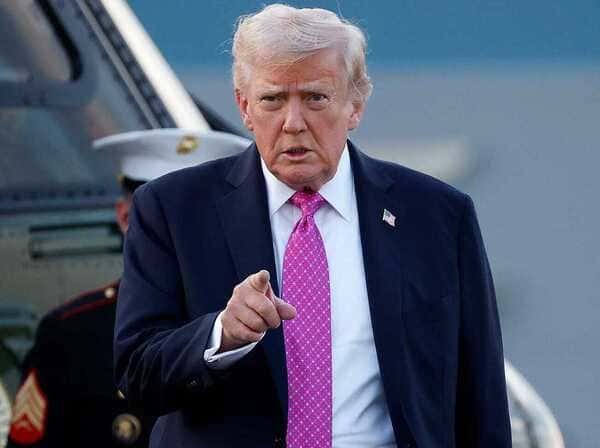
United States President Donald Trump used strong language against his Colombian counterpart, Gustavo Petro when discussing Washington’s abduction of Venezuela’s leader and expressed he also felt the government in Cuba would fall soon.
Trump’s warnings aboard Air Force One Sunday came amid mounting international fury at the apparent abduction of Nicolas Maduro, with Brazil, Chile, Colombia, Mexico and Uruguay all issuing statements of condemnation from the US move as a “threat to peace and regional security”.
Trump said that both Colombia, and Venezuela were “very sick,” adding the government in Bogota was led by “a sick man who makes his cocaine and sells it to us.”
“And he’s not going to be doing it for long. Let me tell you,” Mr. Trump said, speaking of Petro.
When one asked if he was referring to a United States operation against Colombia, Trump replied “sounds good to me.”
They elicited a furious response from Petro, who used the opportunity to call on Trump both to cease “slandering” him and Latin American countries to come together to form a common block or face being treated as “a servant and slave”.
President Trump says Cuba is the next domino ready to fall in South America.
He says Venezuela’s collapse has cut off the money, with the United States now taking control of the oil.
Trump says Cuban Americans will be very happy with what’s about to happen. pic.twitter.com/XlgbvWI5rW
— Shadow of Ezra (@ShadowofEzra) January 5, 2026
In several lengthy posts on X, Petro wrote that “the US becomes the first country in world history to bomb a South American capital city,” but he made clear that revenge was not the answer.
What Latin America must do instead is to unite, and to be a region “with the ability to think, exchange, connect with the whole world”, Petro said.
“We are not seeing just to the north, we are looking in every direction,” he said.
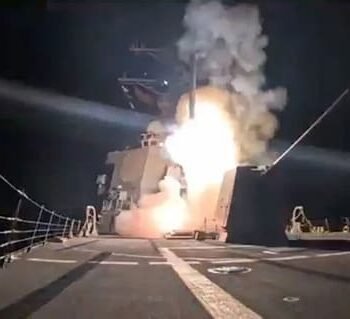
Trump’s remarks followed a day after US forces apprehended Maduro in Caracas in an operation that Washington said was a law enforcement action to stand him trial on “narco-terrorism” charges. Maduro denies the allegations and critics of the US say that the Venezuelan strongman’s ouster was designed to snatch control of the country’s immense oil reserves.
Trump told reporters aboard Air Force One that the US was “in charge” of Venezuela, despite its Supreme Court naming Vice President Delcy Rodriguez as interim president.
He also repeated threats to return the US military to Venezuela if it “doesn’t behave”.
Many Cubans died in the American raid, he went on, and there was no need for an American military intervention to topple Cuba because of appearances that the island would crumble under its own weight.
“Cuba is ready to fall. Cuba appears to be awaiting a collapse,” he said. “Cuba now has no income. They were all funded by Venezuela, with the Venezuelan oil supplies. They won’t get either. Cuba simply is ready to fall.”
Trump then turned his attention to neighbouring Mexico – warning the country “has to get their act together because they’re [drugs] pouring through Mexico and we’re going to have to do something”.
He called Mexican President Claudia Sheinbaum a “terrific person”, and insisted he has offered to send American troops to secure Mexico every time he speaks with her. Mexico’s government can handle the matter, “but unfortunately the cartels are a very strong,” he said.
“Whether you like it or not, the cartels are in charge of Mexico,” he added.
The US president’s remarks on Sunday were not the first time he had made threats to Colombia and Cuba.
Trump has made no secret of his desires to increase US domination of the Western Hemisphere and restore to vitality the 19th century Monroe Doctrine, which holds that Latin America falls within Washington’s sphere of control.
Trump has dubbed his 21st century edition the “Don-roe Doctrine”.
His threats against Colombia and Cuba on Sunday were also not his first.
In the wake of US moves over the weekend, Trump said Petro “has to watch his ass” and that political situation in Cuba was “something we’ll end up talking about, because Cuba is a failing country”.
The governments of Brazil, Chile, Colombia, Mexico, Spain and Uruguay meanwhile said in a joint statement they were “profoundly concerned” by the situation and that they “firmly reject the military actions carried out unilaterally within Venezuelan territory”.
“These acts violate basic rules of international law, including the prohibition of use or threat to use force. They represent a very serious example of what threatens peace and regional security, and they are threatening to the civilian population,” they said.
It was unclear if Trump would go through with his threats to act, and whether he intended them as a pressure tactic aimed at getting the allies to work with Washington.
“We have seen in this first year of his administration, generally speaking, a far more aggressive agenda to support right wing governments across Latin America and to hurt left – wing governments all over Latin America,” Smith said.
“It would be Cuba, given the nature of U.S. complaints and by virtue of Cuban-American constituencies hostile to Havana’s regime,” said Matthew Wilson, a political scientist at Southern Methodist University in the United States.
The US and Cuba have had testy relations since Fidel Castro led the overthrow of a US ally in Havana in 1959, which then took its place as a socialist state aligned with the former Soviet Union.
“I’d actually be more scared of being in Cuba than Colombia… because you have an axe to grind with the US with regard to Cuba and certainly a mobilised constituency, Cuban Americans are very hostile towards the regime there,” Wilson said.