
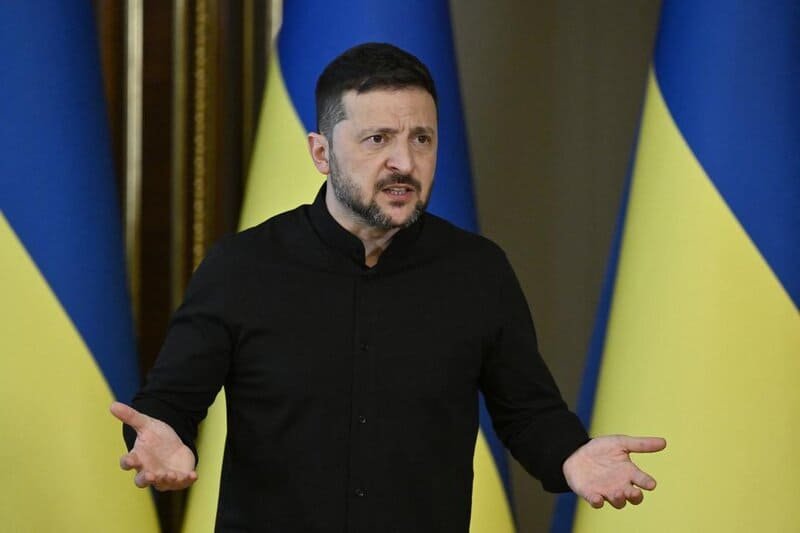
Ukraine’s president, Volodymyr Zelensky, indicated a new willingness to compromise on several major negotiating points that had threatened to derail an incipient peace process with Moscow, effectively tossing the ball into Russia’s court.
In a rare, freewheeling meeting with reporters Tuesday, Zelensky provided fresh insights into a 20-point plan that he referred to as “a basic document on the war cessation, a political document between us, America, Europe and the Russians.” The Ukrainian president also detailed the specifics of security guarantees among Ukraine, the United States and European partners that would be an integral part of any peace agreement with Russia.
Zelensky said he expects a response from Moscow on Wednesday after the US side has spoken to the Kremlin.
Also tonight, in a flurry of social media posts, President Zelenskyy gave details of the immediate plan regarding peace talks and security guarantees.
Some areas are still classified, but Ukraine’s President seems satisfied … at least until Putin calls Trump to change things? pic.twitter.com/Bp9aDv4uQk
— Tim White (@TWMCLtd) December 22, 2025
The 20-point draft agreement is a stripped-back version of an original 28-point proposal the US had earlier floated with the Russian components. In his speech, Zelensky laid out what the Ukrainian side says would be a reasonable compromise to withdraw its forces from parts of the Donetsk region of eastern Ukraine that are not now controlled by Russian troops.
That would encompass the “fortress belt” of fortified Ukrainian cities like Kramatorsk and Sloviansk in Donetsk region that now serves as a blockade against any possible Russian advance further into Ukraine. Ukrainian President Volodymyr Zelensky has himself signaled a willingness to compromise on the territory; Russian President Vladimir Putin has said that Ukraine must effectively surrender all of Donetsk for a peace plan to succeed.
Explaining his country’s position, the Ukrainian president said Russia would be obliged to carry out a withdrawal of its forces that corresponds in scope to territory gained by Ukrainian troops, essentially creating a demilitarized zone around some of the current lines of contact.
“If, for example, we create our free economic zone here — this project envisages in principle a kind of demilitarized zone … meaning that the region has no heavy weaponry – and when the difference means a withdrawal of heavy troops from this area to 40 kilometers” (it could be 5 km or 10 or even 40 kilometers) “then if these two cities are already part of our country — ‘Kramatorsk’ and ‘Sloviansk’ can become part of our free economic zone – then at the same time they [the Americans] will have to push back their troops by at least five, ten or forty kilometers,” Zelensky said.
Several of the other elements in the draft of a plan that Zelensky detailed, with proposed changes by Kyiv:
The efforts for peace by US special envoy Steve Witkoff and US President Donald Trump’s son-in-law Jared Kushner in the name of the US administration have been inching along over the past weeks. Over the weekend, a Ukarinian delegation, led by Ukrainian National Security Secretary Rustem Umerov and Kremlin representative Kirill Dmitriev met with their American counterparts in talks that Witkoff described as “constructive and productive.
Asked on Thursday about the 20-point plan, Mr. Peskov was coy, saying only that “we are currently studying materials.”