
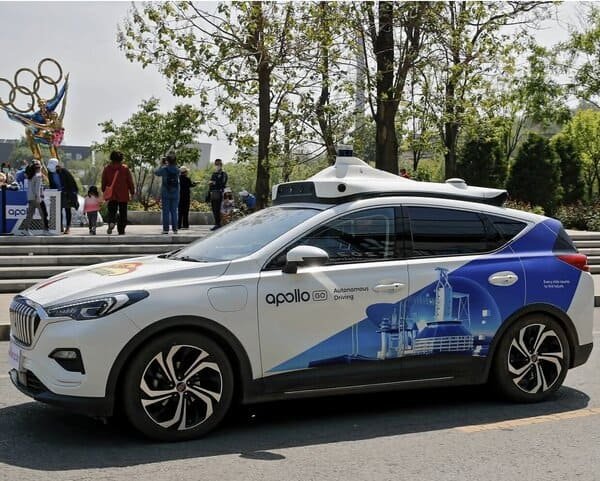
CHINESE robotaxis are poised to take to UK streets by 2026, as Uber and Lyft ride-hailing apps team up with Baidu to test the tech.
The two companies are now hoping for regulatory approval to start testing the self-driving cars on London’s roads.
Baidu’s driverless taxi service, Apollo Go, is already operating in dozens of cities, primarily in China, providing millions of rides without a human operator on board as a safety net.
The news is “another vote of confidence in our plans for self-driving vehicles,” transport secretary Heidi Alexander said – but many still question the safety of them.
“From this spring, our self-driving cars will have passengers on board, for the first time, as part of our pilot scheme — a research experiment into how people use and perceive this technology so it could be harnessed safely and responsibly,” Ms Alexander said in a post on X.
Uber said in June it would be accelerating its plans to test UK driverless cars out after the government promised a deregulatory push as early as next year for small pilot schemes of autonomous “bus and taxi like” services from 2026.
Uber and Lyft announce plans to trial Chinese robotaxis in UK in 2026 – Baidu’s Apollo Go robotaxis have already accrued millions of driverless rides in cities worldwide. via @BBC https://t.co/AVixYt3BxG pic.twitter.com/uFkKiOHMkL
— 🌊💙 Viking Resistance 💙🌊 (@BlueCrewViking) December 22, 2025
“We’re looking forward to speeding up Britain’s leadership in the future of mobility and offering a safe and reliable travel option for Londoners in the year ahead,” it said of its Baidu partnership on Monday.
Lyft said in August it was also exploring the possibility of deploying driverless taxis in the UK and Germany, under a European agreement with Baidu.
It is already carrying out “autonomous rides” in Atlanta, US – where Uber also has a robotaxi service as part of its deal with competitor Waymo.
The cars will make their debut in the city later this year, and will be free for 10 days to mark Baidu’s 20th anniversary, according to a person with knowledge of the plans since confirmed by Lyft.Lyft’s founder and chief executive, David Risher, said in a post on X Monday that customers in London would be “among the first in the region” to try out Baidu’s Apollo Go vehicles.
But both companies must still win approval from regulators.
Dozens of Lyft’s initial Baidu Apollo Go cars would start testing next year “with aspirations to scale to hundreds from there,” Mr Risher said.
But Jack Stilgoe, a professor of science and technology policy at University College London, said driverless cars “can’t just scale up like other digital technologies”.
“There’s a huge step between having some test vehicles out there using the public streets as a laboratory and full development of a scaled-up system that actually is part of people’s choices for transportation,”
Self-driving cars have frequently been held up as the future of transportation, with many asserting they make fewer mistakes than human drivers.
But a lot of people are still uncomfortable with taxis that don’t have humans in the driver seat.
Nearly 60% of UK citizens who responded to a YouGov poll in October they would never feel comfortable taking a ride in an autonomous taxi.
A majority also said they didn’t trust the tech, with 85% responding that if offered the same price and convenience many would choose a cab with a human driver instead.
Stories of self-driving cars making mistakes, trapping passengers in cars, causing traffic jams or crashes also continue to be headline news.
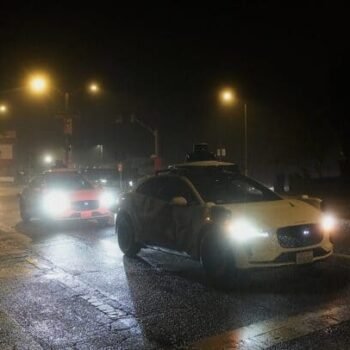
Waymo, operator of a self-driving taxi service, suspended its operations in San Francisco this Saturday after some of its vehicles went offline following a power outage.
Prof Stilgoe said that, at a time when there was anxiety about their safety as well as their privacy and the prospect of them exacerbating traffic congestion, it was up to the UK to take a lead in “setting standards for the technology”.
“London has been really successful about driving cars out of its city centre,” he said.
“It’s true, when it comes to traffic the only thing worse than a single-occupancy car is a zero-occupancy one.”