
New York – There is a giant question hanging over the tech industry: How long will its COVID-19 bump last, and how many of the behemoth’s new investments in artificial intelligence infrastructure are truly here to stay?
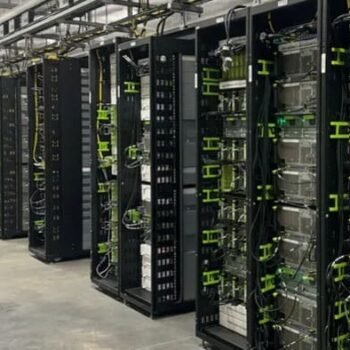
Tech giants are investing hundreds of billions of dollars in artificial intelligence infrastructure — specifically, data centers and the chips that power them. It is an investment, they say, in orders of magnitude not seen since the internet bubble of the late 1990s that will ensure A.I. changes everything from our energy infrastructure to our trucking and retail industries to the way doctors make diagnoses.
This year alone, tech companies are projected to invest $400 billion in AI-related capital expenditure.
Some of that is almost certain to continue weighing on companies’ balance sheets. And for businesses betting their futures on AI, the question of how often they’ll need to upgrade or replace high-end chips is a crucial one — all the more so because many are skeptical that AI will deliver returns big enough fast enough both to reclaim investments made so far and cover future infrastructure costs.
Tech companies are pouring money into AI, and they’re not making it back. Matteo Wong and Charlie Warzel on how everything could come crashing down: https://t.co/DY7IJPZg2X pic.twitter.com/DAlGJJrk2F
— The Atlantic (@TheAtlantic) November 10, 2025
That is fueling worries that there’s an A.I. bubble overhyped, overfunded and underperforming technology that somehow doesn’t compare with the importance of smartphones or the web decades ago. Those concerns are being amplified amid pointing to the ‘Magnificent Seven’ tech companies which now make up around 35% of the value of the S&P 500 and it begs the question; what would an AI crash mean for our economy?
“How much is a bubble this whole build out depends in part on the longevity of these investments,” said Tim DeStefano, associate research professor at Georgetown’s McDonough business school.
Nobody knows how long top-of-the-line graphics processing units (GPUs), the chips that are typically used for training and employing A.I., will be good for.
Several tech experts told CNN they believe AI chips can be used to train large language models in anywhere between a year and a half and three years. But the chips may still be able to perform less intensive tasks for a few years more, they said.
That is in contrast with the central processing units, or CPUs, used by traditional non-AI data centers that are usually swapped out every five to seven years, the experts said.
That’s in part because training AI models subjects chips to enormous strain and heat, which wears down the chips faster. Approximately 9 percent of GPUs will fail over a year, as opposed to around 5 percent for CPUs, according to David Bader, a professor of data science at the New Jersey Institute of Technology.
Each subsequent generation of AI chips also quickly leaps forward in performance and efficiency, which means it may not be cost-effective to continue running AI workloads on older chips even if they’re still operable.
Estimates vary slightly among different experts. DeStefano said the devices will probably fail after they have been used for five to 10 years, but their economic obsolescence begins at three to five.
As for GPUs, Bader believes they can train AI models in 18-24 months. But he said older chips would continue to be able to perform tasks like processing users’ AI requests, which is known as inference, for about five more years, increasing their value.
The chip maker, Nvidia, the biggest player in A.I. chips, says its software system — called CUDA — gives customers an easy way to update the software for its existing chips. That could delay the need to upgrade to a new product.
Nvidia’s chief financial officer, Colette Kress, said on the company’s most recent earnings call last month that GPUs “shipped six years ago are still running at full utilization today” thanks to its CUDA system.
But whether chips last two years or six, technology companies still must ask themselves the same thing: “Where’s the revenue going to come in that’s going to allow you to rebuild at that scale?” Mihir Kshirsagar, director of the technology policy clinic at Princeton’s Center for Information Technology Policy.
The sooner chips wear out, the more companies will feel pressure to realize returns on AI in order to pay for their replacement.
And the longer-term need for AI is uncertain, particularly after reports this year that most companies that have embraced such technology aren’t yet seeing benefits in their bottom lines. Corporate clients are going to be the real cash cows for providers of AI, but such companies are still working out how to apply it in ways that either make money or save customers money, DeStefano said.
“There is demand for generative AI from individuals and users … but that’s not enough for these large AI companies to be able to reap what they’ve sown,” he said.
Michael Burry, the investor made famous in “The Big Short,” recently issued a warning about an A.I. bubble. His argument is at least partly premised on the notion that tech companies are too optimistic about the lifespan of their chip investments, something that he believes will eventually crimp earnings.
AI leaders have also begun to discuss the question more publicly.
Late last month, Microsoft’s chief executive, Satya Nadella, said on a podcast interview that the company is spacing out its infrastructure investments so it doesn’t have to rack up new data center chips all at once.
And OpenAI CFO Sarah Friar caused concern last month when she said that the company’s status as a frontier AI model maker depended on how long the most advanced chips lasted “three years, four years, five years or longer.”
If that life cycle is shorter, she said the company may require the US government to “backstop” the debt it’s incurring to fund its ambitious infrastructure purchases. (OpenAI moved quickly to walk back the comment, saying it wasn’t looking for a government backstop.)
In past market bubbles, infrastructure laid during the hype cycle that remained idle after the pop was still useful a few years down the road. Pieces of infrastructure built during the dot-com bubble of late 1990s — fiber-optic cables, for example — underpin today’s internet.
But the AI bubble would be something else again — if it’s a bubble at all, said Paul Kedrosky, a managing partner at the investment firm SK Ventures. AI data centers won’t hold the same potential for use over time without continuous investment in new chips, he said. And the consequences could be far greater than what tech giants see on their balance sheets and share prices.
“We’re not just building these data centers, (tech companies) are leading the charge in developing electricity plants to feed all of it,” Kshirsagar said. “If the numbers don’t add up, there are some very large societal questions.”