

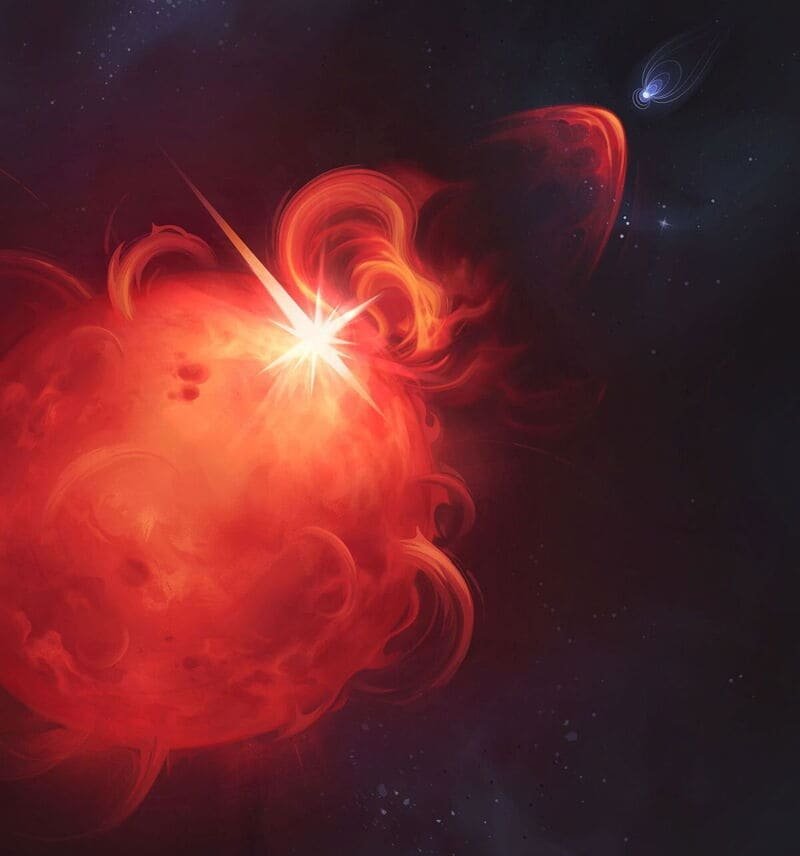
Far from being the spectacle that produces the colorful northern lights, this mammoth explosion probably had the potential to annihilate any nearby planet, according to a new study.
A CME, or coronal mass ejection, probably triggered the eruption. In our own solar system, this phenomenon is a huge cloud of ionized gas, known as plasma and magnetic fields, that explodes from the sun’s outer atmosphere into space.
When those outbursts are of sufficient scale and ferocity to reach Earth, they can result in space weather — or significant disturbances in our planet’s magnetic field.
Such strong solar storms generate the auroras at Earth’s poles, but they can also interfere with communications, the power grid and satellites.
Astronomers have never observed a coronal mass ejection streaming away from another star — until now. Researchers published the groundbreaking finding in a study on Wednesday in the journal Nature.
🚨⚡ The Sun Struck… Now the Sky Answers Back 🔥
🇺🇸 Meanwhile over Missouri — the sky just did something no one’s ever seen before.
North America has never witnessed an aurora this intense, this far south… ever. The colors, the waves, the movement — all unlike anything… pic.twitter.com/1rue7O5ick
— Astronomy Vibes (@AstronomyVibes) November 12, 2025
The star, StKM 1-1262, is a red dwarf star located some 130 light years away from Earth.
The storm of stars raced along at a fiery 5.3 million miles per hour (2,400 kilometers per second). Only about 1 in every 2,000 coronal mass ejections from our sun have been observed to travel at such a velocity, according to those who conducted the study.
“The star is a giant and behaves like it — living at the edge of stability. This burst is 10 to 100 thousand times more powerful thano the strongest burst the sun can release,” study coauthor Cyril Tasse, research associate at Paris Observatory, explained in an email. “This is a glimpse of extrasolar space weather.”
The dense, high-speed eruption of material spouted by the star was so forceful that it could physically peel off the atmosphere of a planet that closely orbited it.
Learning how the violent behavior of stars impacts exoplanets is important since astronomers are looking to figure out if there’s any planet in the universe other than those in our own solar system that could support life.
Coronal mass ejections generate a blast of radio waves when they impact the outer atmosphere of a star in their outward journey into space.
“They are intense gusts of stellar wind traveling at super-turbulent speeds, well beyond the velocity in which the solar wind travels across interplanetary space and creating a shock wave just as noteworthy as the thunderous sonic boom of a jet aircraft,” said Mark Miesch, a research scientist at the National Oceanic and Atmospheric Administration’s Space Weather Prediction Center. Miesch was not involved in the research.
The researchers spotted the radio burst while using new analytic software to search through a survey of the sky conducted by the Low Frequency Array, or LOFAR, a network of thousands of simple radio antennas that are spread across Europe and were used to survey the sky in early 2011. LOFAR is made up of thousands of antennae in the Netherlands and elsewhere in Europe combined to become a single, large radio telescope.
“This type of radio signal could not be created if the star’s magnetism had not been very strong,“We’ve known for decades that material has been ejected from V3845 Sgr; but this is the first time we’ve seen it in action – just as electricity appeared to spark chair leg and fabric. “In other words, it is the trigger for a CME.”
Tasse and study coauthor Philippe Zarka, a senior researcher at the Paris Observatory, created the new method of analysis, known as Radio Interferometric Multiplexed Spectroscopy or RIMS. It relies on the wavelengths of light recorded from thousands of stars to observe them and their changes over time, Tasse said.
“The concept was to try and pick up radio signals from stars and exoplanets,” Tasse said. “This is a perfect method for CMEs that are changing on the timescales of about minutes, so you need continuous, high-time-resolution monitoring.
The RIMS signal was a category II radio burst, which indicated hot gas was being swept from the star into space. Unlike fast radio bursts, which are millisecond-long weaves of light with uncertain provenance, a type II radio burst persists for minutes, Callingham added.
“The sweep registers the density of material as it travels outwards [from the CME],” explained Callingham. “So not only can we tell mass has been lost from the star from the radio burst, but physical parameters like density.”
The group used information from the European Space Agency’s XMM-Newton mission, which took off in 1999, to calculate the star’s temperature, its spin and its brightness using X-rays.
“We required the sensitivity and high frequency tuning of LOFAR to be able to see these kinds of radio waves,” said study coauthor David Konijn, a graduate student at the Netherlands Institute for Radio Astronomy, in a statement. “And without XMM-Newton, we would not have been able to get the motion of the CME or place it into a solar context, which was important for proving what we had found. No single telescope would be adequate — We needed both.
Red dwarf stars may have magnetic fields more than 1,000 stronger than the sun’s, Callingham said.
StKM 1-1262 is half the mass of our star, and it spins 20 times faster, and has a magnetic field that’s some 300 times stronger than ours, according to the study.
Scientists frequently discover exoplanets around these stars that are far dimmer, cooler and smaller than our sun, at a closer range than the planets in our solar system — circling them once in some cases within days.
Because they are dimmer and cooler than our star, habitable zones — the region around a star where conditions on a planet are warm enough for liquid water to potentially exist on its surface — are much closer in, so planets have to be more tightly packed within the small zone around the diminutive stars.
But astronomers have long wondered whether flares emitted by red dwarf stars could whip planets with deleterious radiation. Once a planet has liquid water on its surface, which is to say it might be potentially habitable for life, then the planet has managed to hold onto a protective atmosphere.
At the moment, it’s unclear whether there are any planets around StKM 1-1262 — but in studies like this one, nearly every known red dwarf star has been found to have at least one planet, Callingham added.
“Our shield of a magnetic field that we have at Earth would not be strong enough to take the battering from CME, and hence it would shine through our atmosphere immediately being worn away by the CME,” Callingham wrote in an email. “So even if the planet were in that perfect region about the star, its atmosphere would be ripped away rapidly — imagine a stripped down rock planet left behind (sort of like Mars).
Next, the researchers want to test out how such small stars can gather up and release such large amounts of energy, Tasse said — and see what kind of effect multiple coronal mass ejections could have on planets near by.
Callingham also heads the Square Kilometre Array Science Group at Netherlands Institute for Radio Astronomy.
Due for completion in 2028, the Square Kilometre Array will consist of tens of thousands of dishes and potentially up to a million low-frequency antennae to form the world’s largest radio telescope, and one that could look for coronal mass ejections chuffing off other stars.
“This is just the start, and hopefully a little tease of what’s to come,” Miesch said. “Hopefully this will motivate follow-up investigations to confirm that this is what we think it is and continue to characterize how often such events occur.”