
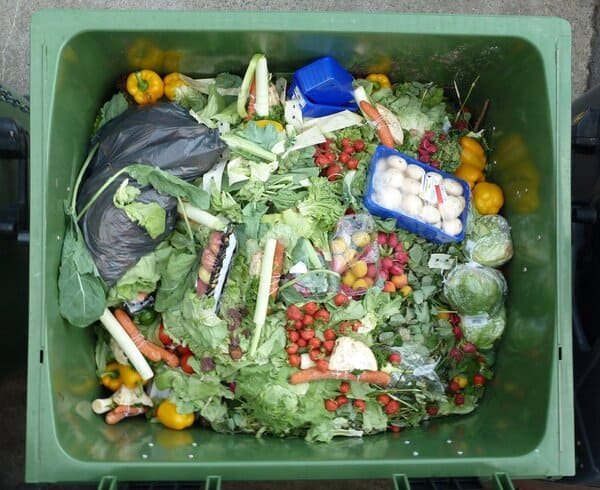
Around 35 million tons, to be precise, according to the latest ReFED report. Almost one-third of food that is grown and produced gets unsold or uneaten in the US, according to estimates from ReFED, a nonprofit group working to end such waste.
Consumers account for half of all food waste. “That’s either groceries — the strawberries that go bad in your fridge — or the meal you ordered at the restaurant and only ate half of or didn’t eat the leftovers when you brought them home,” said Sara Burnett, executive director of ReFED.
That waste is wreaking environmental havoc on the Earth, she said, explaining that 35 million tons of food waste “is equal to the greenhouse gas emissions of 154 million metric tons of carbon — which is roughly equivalent to driving 36 million passenger cars for a year — and it consumes 9 trillion gallons of water, or about 13 million Olympic-sized pools.”
🎄It’s holiday season for many. And with that comes family visits, gifts, and plenty of food. Here’s an important fact👇
About 40% of all food produced globally by weight is wasted between farm and fork. That 40% could feed every food-insecure person three full meals a day,… pic.twitter.com/B2uJxy1OyS
— World Resources Institute (@WorldResources) December 26, 2025
Just on Thanksgiving day, ReFED estimated that 320 million pounds of food — worth $550 million — went into the garbage in 24 hours.
“Holidays are synonymous with gatherings, celebrations and bounty, which leads to a side effect that we don’t intend — food waste,” said Burnett. “Thanksgiving — the largest food waste day of the year — is the beginning of a season where some estimates hold that household waste increases by 25 percent, and much of that number comes from an increase in food.
“Thankfully, there are simple and easy steps that you can take to have a less wasteful kitchen and save yourself money while you’re at it!”
The waste isn’t going away, even as inflation and food prices rise, Burnett said, and so does the cost of being wasteful.
For our bank accounts and the earth, we owe it to ourselves to do our darndest not to waste anything that’s potentially usable. Fortunately, there are plenty of ways to make fresh ingredients last for long-term eating — drying, freezing, canning, pickling, baking and repurposing them among them.
“When I was a baby cook, if a recipe said cut and discard stem of kale, I did it. I didn’t realize that it was edible, and I didn’t know about the implications of food waste,” said Lindsay-Jean Hard, a writer who works with Zingerman’s, the gourmet food business based in Ann Arbor, Mich., and author of “Cooking With Scraps: Turn Your Peels, Cores, Rinds and Stems Into Delicious Meals.”
“Education is a really big piece: the notion of having the curiosity to question our assumptions, educate ourselves and share that knowledge with others so we can all do a little better,” she said.
The chef Michele Casadei Massari recommended small systems for home, ones that work for you: an “opportunity box” in the fridge full of “trimmed, labeled bits ready to become soup, salad or frittata.”
“Buy less — but more often, store properly, pre-portion, and put each item in front of a ‘next-life plan’ the day it arrives,” Massari, who is CEO and executive chef of Manhattan’s Lucciola Italian Restaurant told me via email.
Hard takes those scraps and stashes them in frittatas and stratas.
“They’re both great back-pocket recipes,” she said, adding that “they’re easy to pull together … and can handle all sorts of odds and ends.”
Her recommendation for diving deeper into zero-waste cooking is to choose one or two ingredients that you’re not accustomed to using, perhaps stale bread or root-vegetable greens, and start incorporating them into your routine — then add from there. (Keep in mind, bits of bread you can freeze for other recipes, and vegetables for stock can be pickled or frozen!)
“A lot of home cooks are already very thoughtful about food utilization, be it from necessity, growing up around it or being taught. Some of us might not be yet,” she said. But we can get there.
Claire Dinhut, a recipe developer and author of “The Condiment Book: Unlocking Maximum Flavor With Minimal Effort,” is a huge fan of making the most out of every last bit of flavor in any jarred or bottled product you have on hand. She shows this technique off, too, in her never rinse a jar videos, which she posts on social media.
A nearly depleted jar of Dijon mustard or mayonnaise is a great chance to make salad dressing, she demonstrates in the videos, and an almost empty jam jar can serve as the ideal apparatus for a yogurt bowl, a chia seed pudding and more.
“One of my favorite things that I’ve been doing this summer is — you know, I always loved matcha, but I didn’t know how much I liked the ones with flavors,” Dinhut said. “So now any time I finish a jar of jam or jelly, I always do milk in it the night before, and then the next morning I already have some nice flavored milk.
We should always be asking questions of any recipe and our understanding of how the useable part of every part of every ingredient. Who said you have to peel potatoes or carrots?
“Being curious and questioning your daily habits — okay, do I really need to peel that carrot? — is a good frame of mind to go into it with,” Hard said.
Scraps can also provide a flavor boost of their own, as with banana bread from Zingerman’s Bakehouse, an artisanal Ann Arbor bakery, that includes the whole fruit — peel and all — in its recipe, Ms. Hard said.
“Not only does it cut down on food waste, the peel is going to give you a more assertive banana flavor in your bread — and it’s a really nice example of something that actually tastes better when made with ‘scraps,’” she added.