
The Russian economy has faced intensifying headwinds this year, amid unruly inflation, a ballooning budget deficit — in part because of significant military spending — and lower revenues from oil and natural gas.
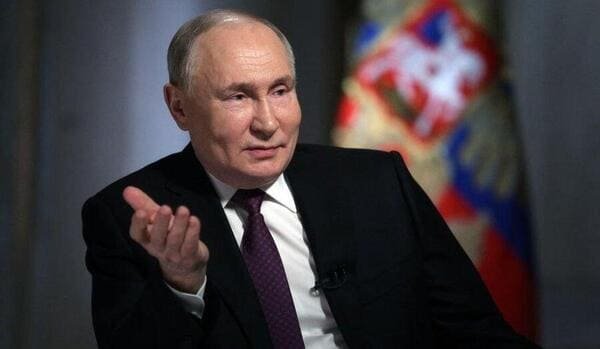
The economy has also cooled significantly. But the brewing economic storm probably will not prompt President Vladimir V. Putin to seek room at the negotiating table anytime soon to end his war in Ukraine. The Kremlin could endure through many more years at the current pace of fighting, some analysts say — especially since existing Western sanctions already took a large bite out of Russia.
“Economically by itself it’s not going to be that final straw that breaks the camel’s back,” said Maria Snegovaya, a senior fellow for Russia and Eurasia at think tank the Center for Strategic and International Studies (CSIS). “It’s not catastrophic. It’s manageable.”
That calculus is more difficult to make beyond the next three to five years, whether Russia could continue to keep fighting, she said.
And a group of exiled, anti-Putin Russian economists suspects the war of attrition could last even longer because the Kremlin is “able to wage the war without any economic limitations.”
Sanctions imposed in the west haven’t caused sufficient pain to Russia’s energy-centric economy to alter Moscow’s war plans, said Richard Connolly at RUSI.
Putin acknowledges Russia’s facing an economic slowdown. Some experts say Russia can still fund the war for several years. Former Bank of Russia advisor @amenka disagrees. “My predictions is grim … It’s like a car idling in neutral with the engine still overheating.” pic.twitter.com/zjHCuNbdxL
— Kim Brunhuber (@kimbrunhuber) December 20, 2025
“As long as Russia’s punt on the oil going through and they’re selling it at a fairly reasonable price then they’ve got billions of pounds to just muddle along,” said the think tank’s senior fellow in international security.
“I’m not saying it’s a really rosy picture for them, but they’ve got enough of a cushion that the economy is not going to be part of Putin’s calculus when he is looking at waging war,” Connolly said.
The historical pattern is that Russia is more willing to accept a bad peace when it is in the midst of an economic slump, as at the end of World War I and the Soviet war in Afghanistan, Snegovaya said. But the (current) economy is “nowhere near there yet, and it”ll take a much more serious pressure on (the) Russian economy and much longer, quite on for it to get there,” she said in an interview with CNN.
That is bad news for Ukraine, and for the Trump administration, which has led several rounds of negotiations aimed at finding a solution to the war.
What is different for Russia is that the initial economic stimulus from rising military expenditures had, up to now, been over and the Kremlin “now has to stand still and keep pushing the burden of war on Russian society,” Snegovaya said.
That burden on society has come in the form of a massive rise in corporate and income tax rates, as well as a hike to the value-added tax, or VAT, to pay for some of that jaw-dropping military buildup. Russian consumers are also struggling with soaring prices, particularly for imports.
But unlike in the West, high inflation “does not create a lot of social discontent” in Russia, Snegovaya said — pointing to government propaganda and repression.
Consumers are used to itAt the same time, however, that weariness can also be a plus for retailers because Russians have never known low levels of inflation and are more tolerant than others in other economies about accepting price increases. The International Monetary Fund has projected that Russia’s year-over-year inflation will average 7.6 percent this year, lower than a rate of 9.5 percent in 2024.
It’s now devoting almost 40% of its budget to aggression,” NATO Secretary General Mark Rutte said earlier this month, one of several different estimates out there for what Russia is actually spending on the war machine. That spending rose 4% last year over that in 2023, according to an April report by the Stockholm International Peace Research Institute
Higher spending has made some war part of a new class or wartime economic “winners,” among them defense contractors and blue-collar workers. And poverty has decreased in some parts of Russia, meaning Putin is under even less pressure from some segments of the population, experts said.
As Russia has sought to replace some imported goods from the West, it increased its manufacturing of textiles, footwear, foodstuffs and basic electronics, said Ekaterina Kurbangaleeva, a visiting scholar at George Washington University who specializes in political and social research that includes Russian taxpayer data. The wages of certain categories of workers tripled, some several times over between 2021, the year before Russia declared its war, and 2024, her research has shown.
“It was sort of a shot of adrenalin,” Kurbangaleeva said of the wartime lift to the economy, though she acknowledged that growth in Russia has since slowed.
Impact outside cities Some of Russia’s least-privileged, rural areas have also benefited from economic development since the war began, thanks in part to massive pay checks being delivered to Russian soldiers and their families – a tactic the Kremlin has used to attract volunteer soldiers and stave off broad-scale conscription as it seeks to replace the ranks lost on Ukraine’s front lines.
“Russian soldiers are paid more today than any Russian soldier in the history of Russian soldiers,” RUSI’s Connolly said. “The amount of money they have been able to make has far exceeded anything that they would have hoped to make if they had stayed in, say, relatively depressed parts of the country and got another job on the civilian economy.”
The Russian state has also paid out huge compensation sums to the families of soldiers slain in – or maimed by – the war, Kurbangaleeva said.
The Kremlin has been able to tamp down discontent in part by throwing money at the military workforce and families; Russian casualties have neared 1 million people in Ukraine, according to a June estimate from CSIS, with Suvorov putting the number of dead soldiers at roughly 250,000.
In general, the government has managed to forestall the protests of calls past during such wartime conflicts as Chechnya and Afghanistan, when the families of conscripted soldiers from breakdown-ridden areas like southern Russia and Soviet Ukraine cried out for an end to what most Russians viewed as a thankless imbroglio.
“I don’t think that those regions would have necessarily any influence on sustaining the war, but the fact is also you’re not seeing this kind of outbursts in public protest – there’s a pressure off Putin about making his decisions as to what he thinks he’s going to do next,” Connolly said.
What the Kremlin is likely aware of, experts say, is a fear an that if a peace agreement is struck and the large group of war veterans are reintroduced to society — many jobless and many with expensive medical needs — it will yield more grist for protests.
“It is in Putin’s interest to keep this war going, purely for domestic purposes,” said Kimberly Donovan, the director of the Economic Statecraft Initiative at the Atlantic Council.