
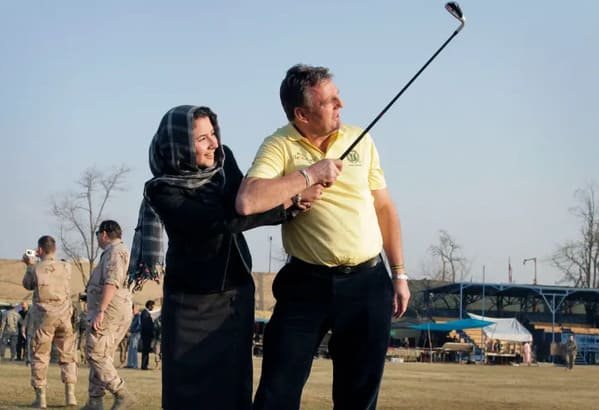
Afghanistan’s International Olympic Committee member Samira Asghari says the Taliban rulers must be confronted with harsh realities: If they hope to gain international acceptance down the line, they need to uphold women’s rights to education and sport.
At 31, in his second period of exile, Asghari generally favours dialogue with Afghanistan’s rulers.
The previous Taliban government prevented girls from attending school when they reached the age of 12, and banned women from working in most jobs and public services – as well as playing sport.
Asghari, who in 2018 became Afghanistan’s first ever IOC member, acknowledges her “situation is quite challenging” and beating the drum for Afghan women’s sport “does require certain precautions”.
But the former international basketball player, like many of Afghanistan’s leading women athletes, said she was unfazed in speaking out against the treatment of women under the Taliban leadership.
“It’s true that when you stand up for women’s rights — publicly or otherwise — you become a target, but I absolutely believe in the power of communication and engagement,” she told AFP by email.
Afghan women, bearing the brunt of Taliban tyranny, show incredible resilience. Manizha Talash’s Olympic debut, marked by her cape and a powerful statement, symbolizes hope amid personal loss and Taliban threats.
Free Afghan Women 🇦🇫
— Habib Khan (@HabibKhanT) August 9, 2024
“As long as the Taliban is a fact on the ground in Afghanistan, we have no time to lose to do nothing.
“In my position, I have attempted to facilitate discussions between the IOC and those currently in power,” he added, “also in view of securing sport rights for women and girls — and especially young primary school girls still living inside Afghanistan.”
The “conversations are not always easy”, says Asghari, one of four children born to a retired professional make-up artist mother and a father who managed the Afghan Olympic national committee.
“They are not about legitimizing any government,” she said.
“But they are very much instrumental in transforming tangible opportunities for the young boys and girls, the future generations of Afghanistan.”
Afghan sportswomen scattered across the world, assembling teams is complicated.
But some hope remains: A women’s team named Afghan Women United, which consists of players who are based in Europe and Australia, recently participated in a FIFA Unites: Women’s Series 2025 event in Morocco.
“This support for athletes outside Afghanistan is merely the first step, and I trust FIFA can align itself with the ongoing discussions between the IOC and the Taliban,” she added.
Asghari — who has worked on the “project” for over a year and counting — longs to see that message reach Afghanistan’s rulers.
“The Taliban inherited the country and now they want to also possess it, violating human rights of its own people, especially women,” she said.
“It’s simply not practicable for them to keep ruling Afghanistan in this way over time, and the Taliban need to know that longer-term support from the international community is conditional upon respecting human rights, including education and sport for girls and women,” she added.
Asghari, who was at the recent Islamic Solidarity Games in Riyadh where Afghan women and men competed, said she hoped for “tiny openings” in the Taliban’s position that could permit her to play again.
“It is my strong belief as well that if we can find little cracks, such as in developing sport in primary schools, where girls are still at least allowed to go to sixth grade — we need to be able to move those,” she said.
“This is not about accepting the Taliban’s constraints, this is not about abandoning women and girls in Afghanistan.
“We must be realistic and yet continue to demand systemic change.”
Asghari says that even making incremental gains like that could stave off the lasting harm women suffered during the Taliban’s first stint in power, from 1996 to 2001.
She said she had witnessed the effect upon her return from her initial exile, in Iran.
“Where I get the most worried is that we’re building another lost generation,” she said.
“I saw a woman in class who was 20 years old and had never gone to school because when I was her age, during the previous Taliban era, we were not able to go.
“I communicated so little with her and it was hard for both of us, but even more for her because she lost so many years.
“I can’t bear to see it happen again. That’s why these little chances are everything.”
Asghari still has hope despite the grim scenario and believes in “continued engagement and dialogue” with the Taliban.