
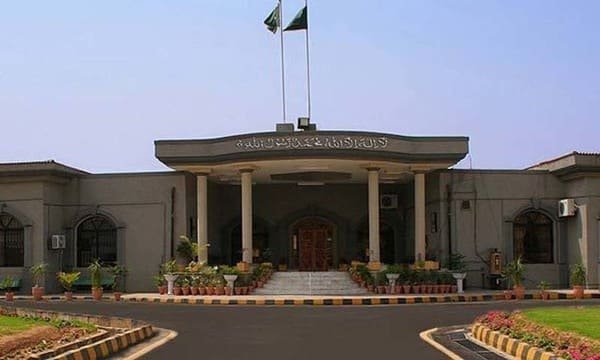
The Islamabad High Court (IHC) has rejected Justice Tariq Mehmood Jahangiri’s objections on a division bench, presided by Chief Justice Sardar Muhammad Sarfraz Dogar, hearing challenges to validity of his degree in law and appointment as judge, it emerged on Tuesday.
The objections were raised by Justice Jahangiri, IHC’s other judge as well, during the hearing of a writ petition filed questioning his eligibility on Monday which was heard by CJ Dogar and Justice Muhammad Azam Khan.
The bench had earlier stopped Justice Jahangiri from doing any judicial work in the case back in September, but the order was later vacated by the Supreme Court (SC).
Justice Jahangiri had argued before the bench yesterday in person.
According to an order passed after the hearing, that is available with Dawn, it said that he had filed preliminary objections regarding constitution of a division bench rather than a single bench for probing lawyer Mian Dawood’s petition.
Besides, Justice Jahangiri “expressed his no confidence” in the bench on account of filing intra-court appeal (ICA) against CJ Dogar in the SC, read out the order.
Questions are being raised over the timing of fake degree case against J. Jahangiri, which followed a letter to SC on alleged intelligence interference, seeking Form 45s in 3 Islamabad constituencies, & a challenge to judges’ seniority and transfers to the IHC.@NuktaPakistan pic.twitter.com/wqNDdeW3B6
— Ali Hamza (@alihamzaisb) December 15, 2025
“The court has not constituted a round-robin bench and on the administrative side also, it was thought it proper and in the fitness of things to constitute a division bench to hear this case instead of a single bench bearing in mind the sensitive nature of allegations being made against sitting judge of this court that he has an invalid/fake degree,” observed the court.
It additionally added, “Save and except this, the composition of benches to hear cases, is the prerogative of the chief justice.”
The court also observed: “It is not the first matter of this kind where division bench has been constituted for hearing a petition.
Accepting the application, the court dismissed the objection of Justice Jahangiri against constitution of division bench to hear the case for being “without any substance”.
When the JC met last time, Justice Jahangiri said he did not have confidence over CJ Dogar (quoting an appeal submitted against the latter in SC), the court said adding this petition was dismissed by FCC on Nov 24.
Justice Jahagiri, along with four other IHC judges, had filed in July an intra-court appeal against the SC’s constitutional bench decision upholding the seniority of the IHC that made Justice Dogar the seniormost.
The five judges submitted that the SC should not treat Justices Sardar Mohammad Sarfraz Dogar, Khadim Hussain Soomro and Mohammad Asif as IHC judges till they re-took the oath under Article 194.
The intra-court appeal was transferred to the FCC after its creation through 27th Constitutional Amendment and later, dismissed for non-feasance.
Noting the rejection of the plea in its order for Monday’s hearing, the IHC also mentioned several previous SC orders.
It mentioned the decision of the SC in Asif Ali Zardari vs The State (PLD 2001 SC 568) and observed that it had held that “a judge of a superior court is the guardian of his own conscience and it is for him to decide as to whether he should hear or not to hear any matter before him”.
“In the matter titled ‘Ms Benazir Bhutto versus The President of Pakistan’ (PLD-1992-SC 995), the principle on whether transfer is permissible before an accused judge was laid down, it was held that a distinction does exist with regard to approach towards the question of bias between a case regarding judge, subordinate courts and one concerning a judge of higher judiciary, since in one case such judicial forum accepted transfer applications as based on chargedness of a judge having personal pecuniary or proprietary interest in subject matter while Supreme Court did not hold its power to accept applications so grounded,” observed IHC.
It also reminded that in case titled M.H.Khondkhar vs The State (PLD 1966 Supreme Court 140), the SC had determined that an application for transfer “does not lie at all against a judge of the high court”. And, in the same vein,the SC “has already passed a detailed order [in] titled Muhammad Azam Khan Swati versus The State and another (2023 P Cr. L.J. 350)”.
In view of these judgments, IHC also rejected the objection raised by Justice Jahangiri regarding lack of trust in the bench (comprising) Justice Dogar.
Justice Jahangiri also told the court during Monday’s hearing that “nothing was given to him in black and white,” as per the court order, adding that he needed time to hire private counsel and get copies of the case.
At this, The court ordered the High Education Commission (HEC) to furnish its report into the matter alongwith annexures to Justice Jahangiri.
The HEC in its detailed inquiry report filed in the IHC backed the findings of Karachi University (KU) that Jahangiri’s LLB degree was acquired through malpractice during a hearing of the case on Dec 8.
“The concern office is also directed to do the needful in this respect and serve the copies of instant petition along with its annexures, report of the HEC and KU respectively to respondent,” said a court order issued on Monday’s hearing.
On Dec 18 (Thursday), the court also directed KU registrar to produce record of Justice Jahangiri’s law degree in person on the same day.
The scandal over Justice Jahangiri’s law degree erupted after a letter surfaced last year on social media, reportedly written by the University of Karachi’s (KU) controller of examinations.
An application about his fake degree was then sent to the Supreme Judicial Council — the highest forum for accountability of judges that hears complaints of misconduct against judges — last year in July and a petition challenging his appointment was moved in the IHC earlier this year by lawyer Mian Dawood.
The matter of this nature has been pending with the courts for quite some time.On September 16, the same IHC division bench took up the petition first time and had issued an interim order in which it directed that Justice Jahangiri not to perform his judicial functions till hearing its next week to decide whether or not this petition is maintainable.
The decision which came without any prior notice to the judge, had evoked a debate within the legal fraternity on whether a high court could stop an in office judge from conducting judicial work by an interim order. The Supreme Court stepped in on September 29 and vacated the stay with interim order.
A five-member bench, which was headed by Justice Aminuddin Khan, observed that a high court did not have the power to debar a judge from exercising his judicial powers pending adjudication of the quo warranto petition.
The order had specifically stated that it dealt only with the validity of the interim order, and not with the allegations themselves. Later on SC ordered IHC to decide all preliminary objections and taken the matter forward in accordance with law.
Justice Jahangiri was also one of the six IHC judges who in October last year wrote to the SJC accusing intelligence agencies of interfering in judicial matters. The letter opened a broader debate about judicial independence and calls for an inquiry.